

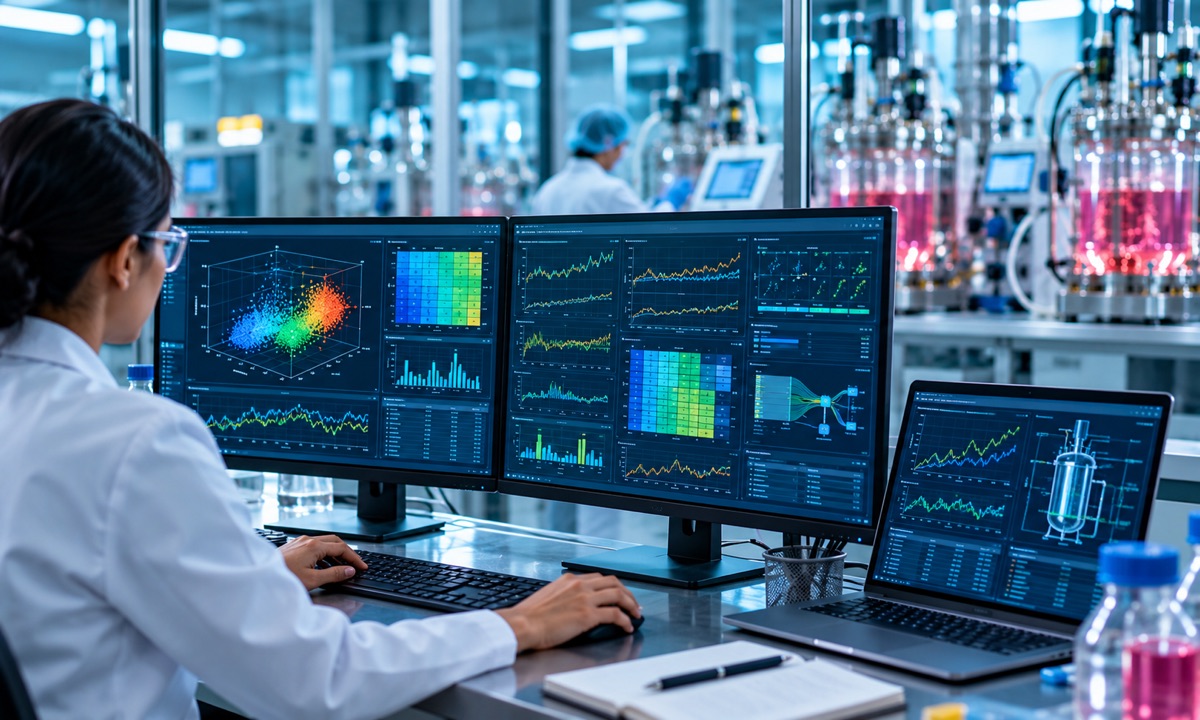
Bioprocess development is increasingly data-rich, multidimensional and predictive. Z2's strength lies in the biology and the process: understanding what the data mean, which questions are worth asking of them, and what development decisions should follow.
Where a programme needs specialist AI, machine learning or advanced modelling, Z2 engages external data scientists and modelling specialists under CDA, who build and run those tools under our scientific direction. For clients, it remains one engagement with one point of contact: you bring the development problem, and we manage everything from framing the question to delivering clear, practical recommendations.
The aim is the same: to move beyond simply "running more experiments" towards smarter experimental design, more knowledge from existing data, and better decisions earlier – reducing unnecessary experimentation, development time and technical risk.
Where data and AI add value
Media optimisation
Data-driven and model-guided exploration of media and feed composition, interpreted against cell biology and process performance.
Process understanding
Multivariate analysis to reveal how parameters, metabolism and outcomes interact.
Predictive modelling
Mechanistic, statistical and hybrid AI/ML models, developed with our specialist partners, to anticipate performance and scale effects.
Critical process relationships
Identifying the relationships that matter, to focus experimentation and control strategy.
How we work
1. You bring the problem
A titre plateau, an unstable clone, a scale-up gap, or a data set you are not getting value from.
2. We frame the question
Z2 defines what the analysis needs to answer, what data are required and which approach fits.
3. Specialists execute
Where advanced modelling or machine learning is needed, our partner specialists build and run the models, coordinated by Z2.
4. We interpret and advise
Z2 reviews the outputs in their biological and process context and turns them into accurate, actionable recommendations.
Tools and approaches
Led by Z2
- Design of Experiments (DoE) and response-surface methods
- Multivariate data analysis (MVDA) and interpretation
Delivered with specialist partners, directed and interpreted by Z2
- Mechanistic and hybrid (mechanistic + machine learning) models
- Machine learning on historical and experimental bioprocess data
- Interpretation of process analytical technology data, including Raman spectroscopy
Recent research illustrates the potential: an explainable AI-driven flux balance analysis of CHO cells during prolonged passaging linked a ~35% fall in peak antibody titre to underlying metabolic changes.1
Where Z2 helps
Biological and process understanding first, then the right analytical or AI tool, whether applied by Z2 or by our specialist partners. Either way, Z2 stays accountable for the science, so models answer real development questions and data inform decisions earlier.
Sources
- Exploring CHO cell stability during prolonged passaging via explainable AI-driven flux balance analysis. PMC12992790. PMC